Greece · 399 BC
Trial of Socrates
Condemned for impiety and corrupting the young — philosophy and civic religion collide in court.
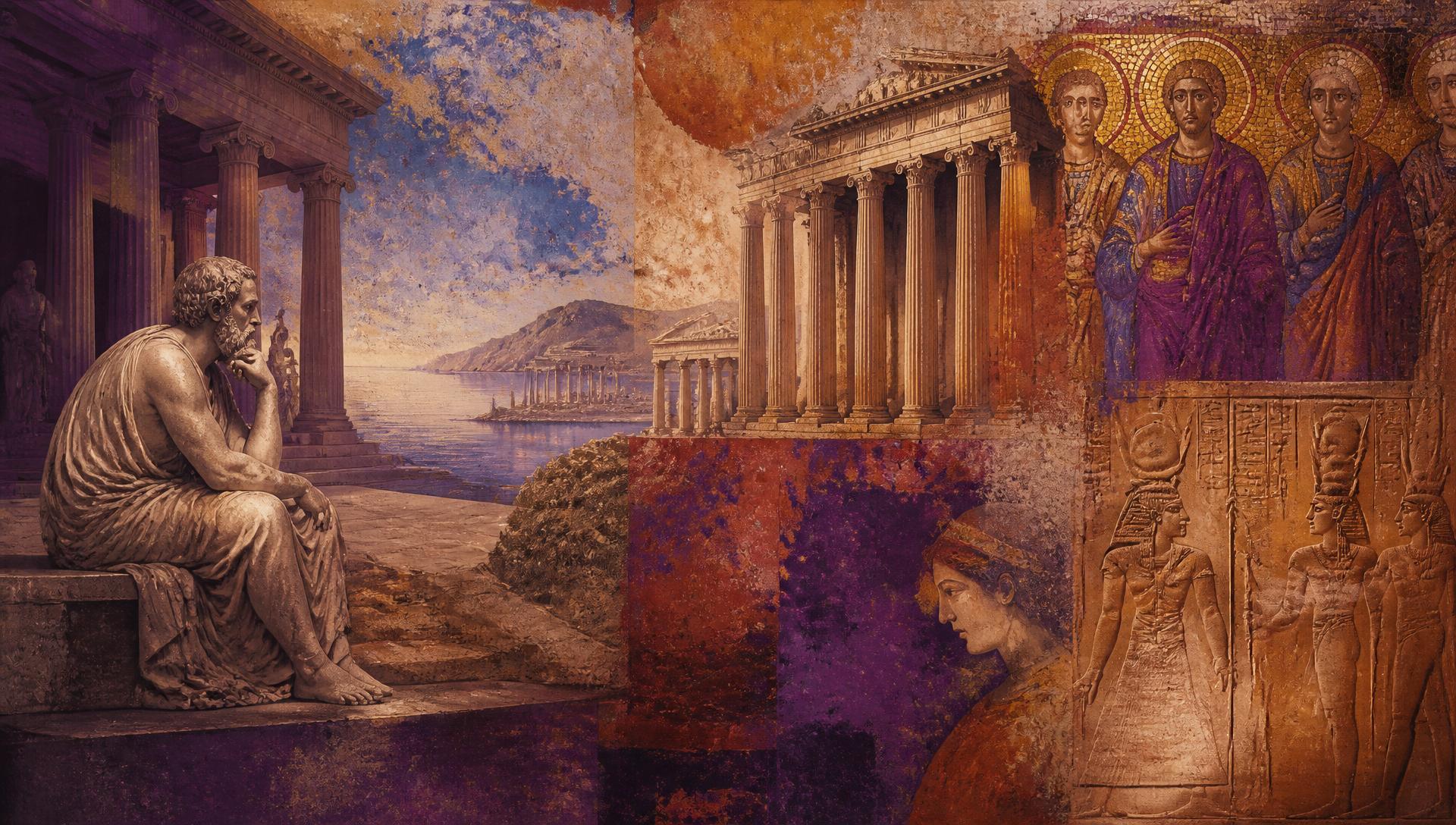
Greece · Rome · Byzantium · Egypt
An interactive study of how four civilizations answered the same questions — what the world is made of, who owes what to the gods, and what becomes of a person afterwards. Follow the timeline, open a tradition, and compare the answers side by side.
Chronology
Filter by civilization and select any marker to read what changed. The rail is ordered by date, from the unification of Egypt to the last Byzantine councils.
Greece · 399 BC
Condemned for impiety and corrupting the young — philosophy and civic religion collide in court.
The Explorer
Choose a civilization to read its religious settlement, then open any tradition for its tenets, practice, doctrine of the afterlife and legacy.
A civic religion of city gods and civic festivals, shadowed by a new profession: men who asked what the world is made of and how a life should be lived.
Greek religion had no scripture, no creed and no priestly caste separate from the citizen body. It was a matter of doing rather than believing: sacrifice at the right altar, at the right time, in the right words. Each polis kept its own calendar and its own patron deity — Athena over Athens, Hera over Argos, Apollo at Delphi speaking for all of Hellas through the Pythia.
Alongside the civic cults ran the mysteries — Eleusis, Samothrace, the Orphic and Dionysiac circles — which offered the individual initiate something the state cult never promised: a personal fate after death.
From the sixth century BC the Ionian physiologoi began explaining the cosmos without invoking the gods, and after Socrates the question shifted from the nature of matter to the nature of the good life. By the Hellenistic age the schools of Athens — Academy, Lyceum, Stoa and Garden — functioned as competing prescriptions for happiness in a world of vast kingdoms where the citizen no longer governed himself.
Side by side
Select a question to see how each civilization answered it. The differences are rarely about the gods themselves — they are about what religion is for.
Arche, the Forms, or the rational logos pervading matter
The numinous power of place, state and emperor, borrowed from Greek theory
A Trinitarian God whose essence is unknowable and whose energies are shared
Maat — order — sustained by gods and king against chaos
Portraits
Sages, bishops, emperors and one freed slave — the people who framed the questions and, occasionally, enforced the answers.
c. 535–475 BC · Presocratic
Reality is process; the logos is the measure within the flux.
469–399 BC · Moral gadfly
Definition of the virtues is the first task of a serious life.
428–348 BC · Founder, the Academy
The Forms are real; the visible world is their shadow.
384–322 BC · Founder, the Lyceum
Everything is understood through its end — its purpose.
341–270 BC · Founder, the Garden
Fear of gods and death is the root of misery; physics removes both.
334–262 BC · Founder, the Stoa
Live in agreement with nature, which is to live by reason.
106–43 BC · Statesman, eclectic
Translated Greek philosophy into Latin and into political language.
4 BC–AD 65 · Stoic, minister to Nero
Philosophy is therapy administered in letters.
AD 50–135 · Freed slave, teacher
Freedom is the correct use of impressions.
AD 121–180 · Emperor, Stoic
Do the work in front of you as a citizen of the cosmos.
AD 204–270 · Neoplatonist
All things flow from the One and long to return to it.
AD 354–430 · Bishop of Hippo
Neoplatonic ascent rewritten as grace, will and interior time.
AD 330–379 · Cappadocian Father
Use pagan letters as the bee uses the flower.
c. AD 500 · Mystical theologian
God is best approached by unknowing and negation.
AD 675–749 · Defender of images
Because God took matter, matter can bear his image.
AD 1018–1078 · Court philosopher
Revived Plato at the heart of an Orthodox court.
AD 1296–1359 · Hesychast theologian
God's energies are shared though his essence is not.
c. 2400 BC · Vizier, sage
The oldest surviving wisdom instruction: speak measuredly, act by maat.
c. 2650 BC · Architect, later deified
Human wisdom elevated to divinity — a god of healing by the Late Period.
d. c. 1336 BC · Heretic pharaoh
One visible god, and the king as its only interpreter.
legendary, texts c. AD 100–300 · Attributed sage
As above, so below: the mind is kin to the divine.
Lexicon
Fourteen terms that appear throughout the dossiers, in Greek, Latin and Egyptian.