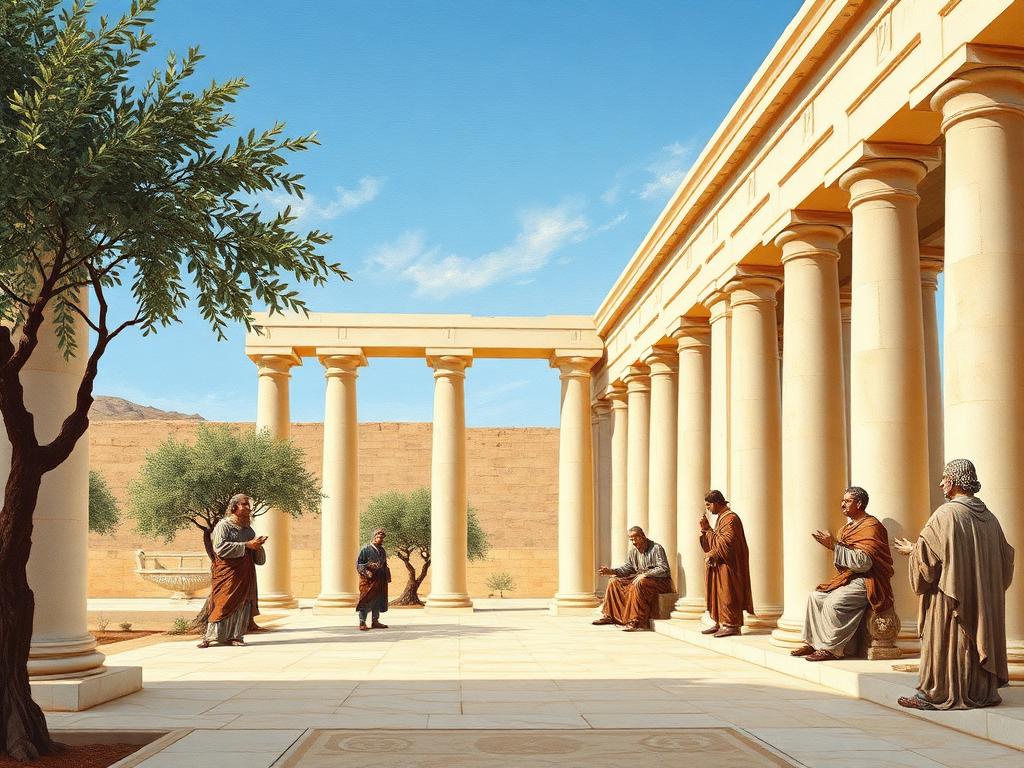
Greece
c. 800 BC – 30 BC
A civic religion of city gods and civic festivals, shadowed by a new profession: men who asked what the world is made of and how a life should be lived.
71 slides, one per page. Print and choose “Save as PDF”.
Greece · Rome · Byzantium · Egypt
How four civilizations answered the same questions — what the world is made of, who owes what to the gods, and what becomes of a person afterwards.
Contents
c. 800 BC – 30 BC
A civic religion of city gods and civic festivals, shadowed by a new profession: men who asked what the world is made of and how a life should be lived.
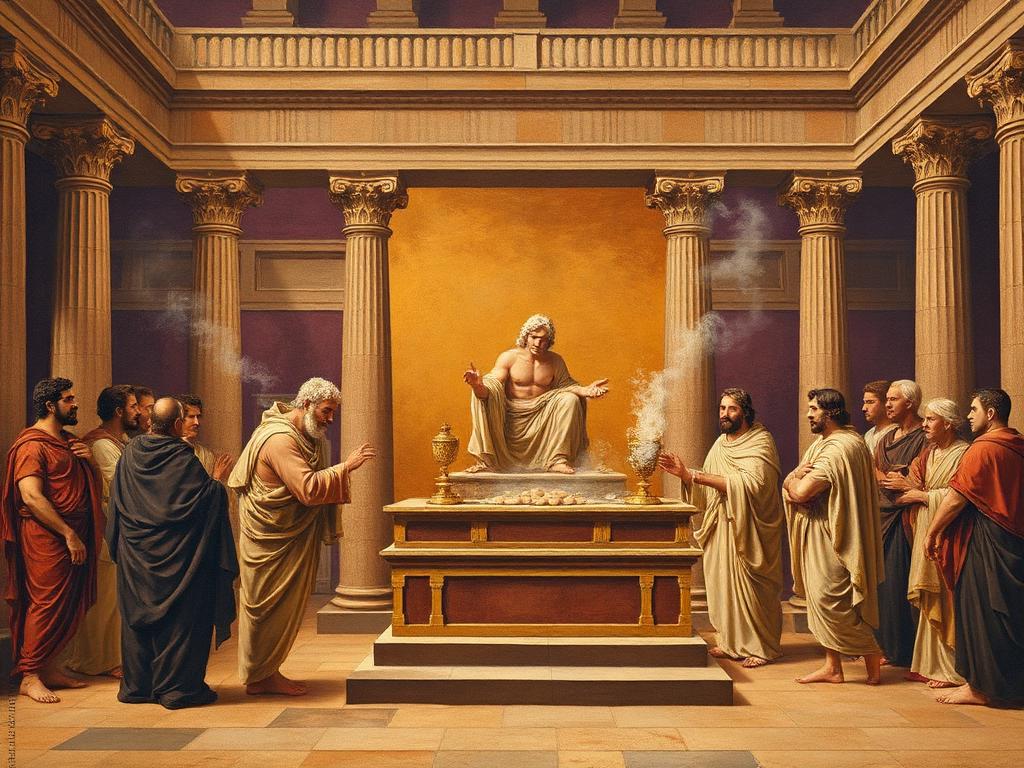
c. 753 BC – AD 476
Religion as public law. Rome measured piety by correct procedure and by results: the pax deorum kept the state safe, and philosophy was imported to teach its rulers restraint.
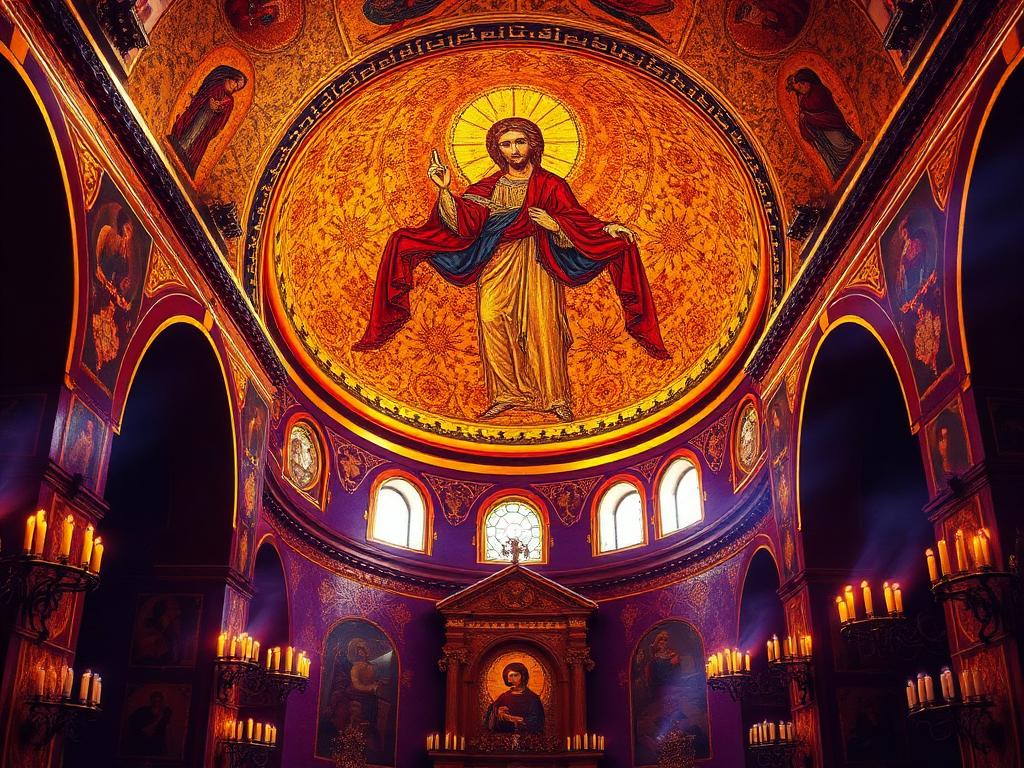
AD 330 – 1453
A Christian empire where doctrine was policy. Councils defined the divine, emperors enforced it, and Greek philosophy survived inside theology.
c. 3100 BC – AD 400
The longest continuous religious tradition of antiquity: a cosmos held in balance by ritual, kingship and the moral weight of a single feather.
c. 800 BC – 30 BC
The Argument in the Agora
A civic religion of city gods and civic festivals, shadowed by a new profession: men who asked what the world is made of and how a life should be lived.
Greece
Greek religion had no scripture, no creed and no priestly caste separate from the citizen body. It was a matter of doing rather than believing: sacrifice at the right altar, at the right time, in the right words. Each polis kept its own calendar and its own patron deity — Athena over Athens, Hera over Argos, Apollo at Delphi speaking for all of Hellas through the Pythia.
Alongside the civic cults ran the mysteries — Eleusis, Samothrace, the Orphic and Dionysiac circles — which offered the individual initiate something the state cult never promised: a personal fate after death.
Greece
From the sixth century BC the Ionian physiologoi began explaining the cosmos without invoking the gods, and after Socrates the question shifted from the nature of matter to the nature of the good life. By the Hellenistic age the schools of Athens — Academy, Lyceum, Stoa and Garden — functioned as competing prescriptions for happiness in a world of vast kingdoms where the citizen no longer governed himself.
Greece · What mattered most
Excellence
The fulfilment of one's purpose — the best possible version of oneself in intellect, body and character.
Moderation
Balance and self-restraint. Unchecked passion, the Greeks held, ends in ruin.
Sacred hospitality
The ritual obligation to honour guests and strangers, guarded by Zeus himself.
Glory
Imperishable fame won by great deeds, keeping a name alive after death.
Greece
State cult
c. 800 BC – AD 400
Mystery cult
c. 1500 BC – AD 392
Mystery cult
c. 550 BC – AD 300
Philosophy
c. 600 – 400 BC
Philosophy
469 BC – AD 529
Philosophy
335 BC – c. AD 200
Philosophy
c. 301 BC – AD 200
Philosophy
307 BC – AD 300
Philosophy
c. 400 BC – AD 200
Greece · State cult · c. 800 BC – AD 400
Twelve principal deities honoured by the city on behalf of the city. Belief was optional; participation was not.
“If oxen and horses had hands, they would draw the gods in their own likeness.”
Founder
Homeric and Hesiodic tradition
Seat
Every polis; Olympia, Delphi, Delos
Practice
Animal sacrifice at open-air altars, libation, votive dedication, hymn and procession; civic festivals such as the Panathenaia, and Panhellenic games at Olympia and Delphi.
Afterlife
A shadowy, undifferentiated Hades for most; Elysium for a favoured few; Tartarus for offenders against the gods.
Legacy
Supplied the entire mythological vocabulary of Western art and, via interpretatio graeca, the framework onto which Roman and later Egyptian deities were mapped.
Greece · Mystery cult · c. 1500 BC – AD 392
The most prestigious initiation in the Greek world, open to anyone who spoke Greek and had not shed blood — including women and slaves.
“Blessed is he among men on earth who has seen these mysteries.”
Founder
Cult of Demeter and Persephone
Seat
Eleusis, near Athens
Practice
A fourteen-mile procession along the Sacred Way, fasting, the drinking of the kykeon, and a night rite in the Telesterion involving things done, things said and things shown.
Afterlife
A blessed existence for initiates, explicitly contrasted with the grey Hades awaiting the uninitiated.
Legacy
The template for personal salvation religion in the Mediterranean; closed by Theodosius I in 392 and the sanctuary sacked by Alaric in 396.
Greece · Mystery cult · c. 550 BC – AD 300
Ascetic brotherhoods teaching the transmigration of souls, ritual purity and the mathematical structure of reality.
Founder
Attributed to Orpheus; Pythagoras of Samos
Seat
Southern Italy, Sicily, Thrace
Practice
Communal life, purification rites, memorised verses; gold leaf tablets buried with the dead giving directions and passwords for the underworld.
Afterlife
A cycle of rebirth ending in release and return to the divine — the earliest Greek doctrine of an earned immortality.
Legacy
Shaped Plato's psychology directly, and through him the entire Western tradition of an immortal, immaterial soul.
Greece · Philosophy · c. 600 – 400 BC
The first attempt to explain nature by nature — arche, flux, being and atoms replacing genealogies of gods.
“You cannot step twice into the same river.”
Founder
Thales of Miletus
Seat
Miletus, Ephesus, Elea, Abdera
Practice
Observation, geometrical reasoning, cosmological speculation and written prose treatises — the birth of theory as a genre.
Afterlife
Largely silent or materialist; Democritus held that the soul dissolves with the body.
Legacy
Established the physical sciences and the vocabulary — element, cosmos, atom, logos — still in use.
Greece · Philosophy · 469 BC – AD 529
Ethics made the central question, and reality relocated from the visible world to the intelligible Forms.
“I know that I know nothing.”
Founder
Socrates; Plato (Academy, 387 BC)
Seat
Athens
Practice
Elenchus — cross-examination in the agora; later, dialectic and mathematics in a walled school with a communal life of study.
Afterlife
The soul is immortal, judged, and reincarnated according to the life it led (Myth of Er).
Legacy
Nine centuries of continuous teaching until Justinian's closure in 529; the source of Neoplatonism and, through it, of Christian and Islamic metaphysics.
Greece · Philosophy · 335 BC – c. AD 200
Empirical, encyclopaedic and teleological: understand a thing by understanding what it is for.
Founder
Aristotle of Stagira
Seat
Athens, Alexandria
Practice
Systematic collection — of constitutions, animals, arguments — lectures while walking the peripatos, and the first research library.
Afterlife
Only the active intellect (nous) may be deathless; personal survival is doubtful and much disputed by later commentators.
Legacy
Logic, biology, poetics and ethics as disciplines; transmitted through Syriac and Arabic to become the backbone of medieval scholasticism.
Greece · Philosophy · c. 301 BC – AD 200
A cosmos governed by rational providence, and a self governed by the distinction between what is up to us and what is not.
“Some things are up to us and some are not.”
Founder
Zeno of Citium
Seat
The Painted Stoa, Athens; later Rome
Practice
Daily self-examination, premeditation of adversity, discipline of assent, and unflinching participation in public duty.
Afterlife
The soul survives at most until the next universal conflagration (ekpyrosis), when all returns to fire and begins again.
Legacy
The dominant ethic of the Roman governing class; a direct ancestor of natural-law theory and of modern cognitive therapy.
Greece · Philosophy · 307 BC – AD 300
Atoms, void and friendship. Pleasure understood as the absence of bodily pain and mental disturbance.
Founder
Epicurus of Samos
Seat
The Garden, Athens; Herculaneum
Practice
Communal life in a garden outside the city, plain diet, memorised maxims (the Kyriai Doxai), and the study of physics purely to dispel fear.
Afterlife
None. The soul is atomic and disperses at death — which is precisely the consolation.
Legacy
Preserved in Lucretius' De Rerum Natura; rediscovered in 1417 and a decisive influence on early modern materialism and secular ethics.
Greece · Philosophy · c. 400 BC – AD 200
Two refusals: the Cynic refusal of convention, and the Sceptic refusal of assertion.
Founder
Diogenes of Sinope; Pyrrho of Elis
Seat
Athens, Corinth, everywhere and nowhere
Practice
Cynics practised public poverty, begging and deliberate scandal; Sceptics practised argument on both sides of any question and followed appearances without belief.
Afterlife
Not a subject for assertion in either school.
Legacy
Cynicism fed Stoic ethics and the Christian ascetic ideal; Sextus Empiricus' Scepticism, printed in 1562, triggered the crisis of doubt that shaped Descartes and Hume.
c. 753 BC – AD 476
The Peace of the Gods
Religion as public law. Rome measured piety by correct procedure and by results: the pax deorum kept the state safe, and philosophy was imported to teach its rulers restraint.
Rome
Roman religion was orthopraxy carried to its logical end. The colleges of pontiffs, augurs and haruspices existed to maintain the pax deorum — the negotiated peace between the city and its gods — through vows, expiations and the reading of omens. A misread bird sign could halt an election; a botched formula meant the whole rite began again.
Rome absorbed rather than suppressed. Greek gods were identified with Italic ones, the Magna Mater arrived from Phrygia in 204 BC by senatorial decree, and conquered peoples' deities were invited to Rome by the ritual of evocatio. From Augustus onward the living emperor's genius and the deified dead emperors became the empire's shared loyalty test.
Rome
Philosophy came as a Greek import and was naturalised as a school for governing classes. Stoicism above all — through Seneca, Musonius Rufus, Epictetus and Marcus Aurelius — supplied a vocabulary of duty, self-command and cosmopolitan obligation that fitted Roman public life better than the withdrawal of the Epicureans.
Into this crowded field came the eastern cults of Isis and Mithras, and finally Christianity, whose refusal of the imperial sacrifice made it not merely a religion but a political question.
Rome · What mattered most
Devotion
Unquestioning loyalty to the gods, the state and one's family and ancestors.
Dignity
Solemnity and self-command — an unyielding bearing in the face of hardship.
Courage
From vir, 'man': bravery in battle, moral fortitude and political integrity.
Standing
Influence accumulated through military success, public service and respect for tradition.
Rome
State cult
c. 753 BC – AD 392
State cult
27 BC – AD 395
Philosophy
c. 50 BC – AD 180
Mystery cult
c. AD 80 – 400
Mystery cult
204 BC – AD 400
Religion
c. AD 30 – 380
Religion
c. AD 100 – 500
Philosophy
AD 245 – 529
Rome · State cult · c. 753 BC – AD 392
The public cult of the Roman people: contractual, legalistic and inseparable from the constitution.
Founder
Attributed to Numa Pompilius
Seat
Capitoline Hill, Rome
Practice
Sacrifice under the veiled head, precise formulae repeated on error, taking the auspices before all public business, and the household cult of Lares, Penates and the paterfamilias' genius.
Afterlife
Vague and largely uninteresting to the state cult; the di manes of the ancestors were honoured at the Parentalia rather than described.
Legacy
Pontifex Maximus survives as a papal title; the Roman calendar, augural vocabulary and legal-religious formalism run through Western institutions.
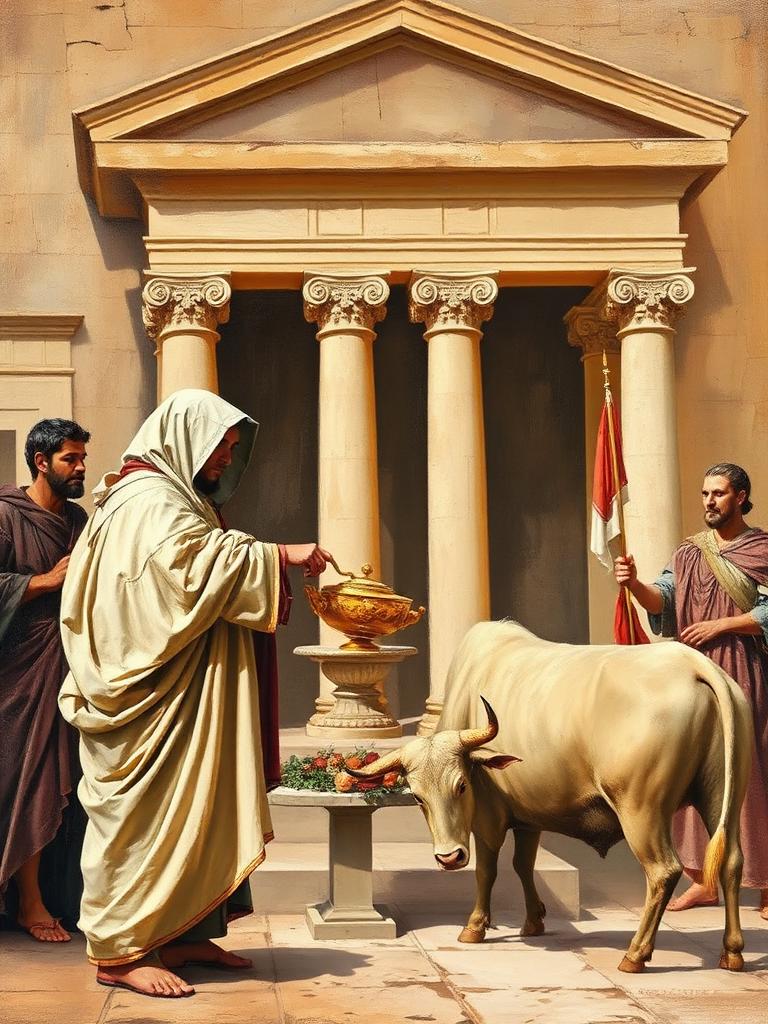
Rome · State cult · 27 BC – AD 395
Loyalty made liturgical. The genius of the living emperor and the divinity of the deified dead bound a multi-ethnic empire together.
Founder
Augustus and the Senate
Seat
Provincial temples from Pergamon to Lyon
Practice
Provincial temples, priesthoods (flamines, Augustales), imperial birthdays in the civic calendar, oaths by the emperor's genius, and a pinch of incense before his image.
Afterlife
Deification for the emperor; for others, the cult offered civic belonging rather than personal salvation.
Legacy
The sacrifice test that defined Christian martyrdom, and the origin of the sacral monarchy inherited by Byzantium.
Rome · Philosophy · c. 50 BC – AD 180
Greek Stoic physics quietly de-emphasised, its ethics sharpened into a practical discipline for senators, slaves and one emperor.
“You have power over your mind — not outside events. Realise this, and you will find strength.”
Founder
Panaetius, Posidonius; then Seneca
Seat
Rome; Nicopolis
Practice
Evening review of the day's conduct, letters of moral instruction, philosophical direction of the powerful — and, under Nero and Domitian, principled opposition and exile.
Afterlife
Dissolution into the elements; Marcus Aurelius treats either dispersal or a further ordering as equally acceptable.
Legacy
Seneca's Letters, Epictetus' Discourses and the Meditations remain the most widely read philosophical works of antiquity.
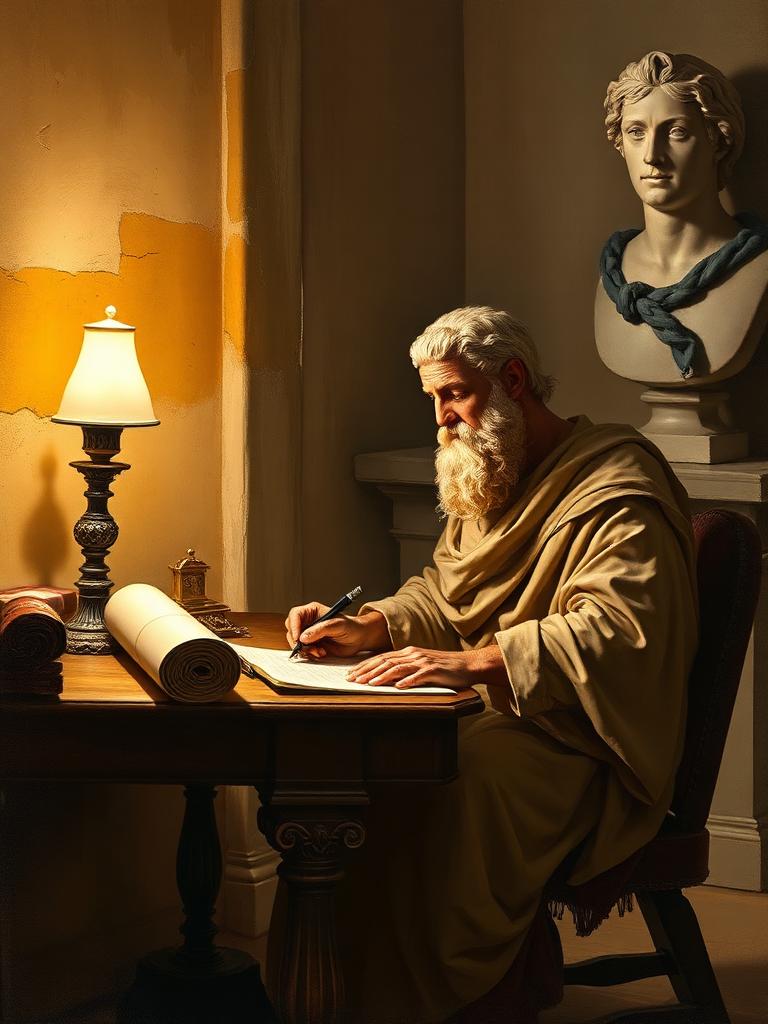
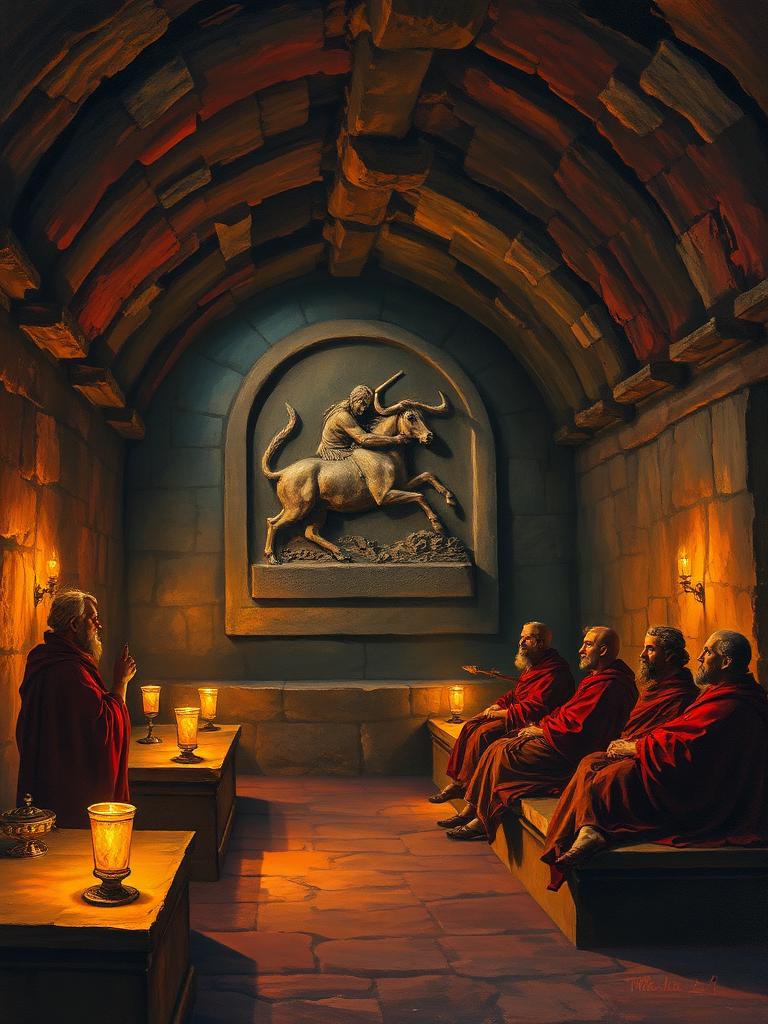
Rome · Mystery cult · c. AD 80 – 400
A men-only initiatory cult of soldiers, officials and merchants, structured in seven grades under a cosmic bull-slaying.
Founder
Unknown; Persian imagery, Roman construction
Seat
Underground mithraea along the frontiers
Practice
Cave-like mithraea seating twenty or thirty, ritual meals, ordeals of initiation, astronomical iconography and absolute secrecy.
Afterlife
Astral ascent of the purified soul through the planetary gates.
Legacy
Christianity's closest structural competitor in the third century; over 400 mithraea are archaeologically attested from Hadrian's Wall to the Euphrates.
Rome · Mystery cult · 204 BC – AD 400
Foreign salvation cults, alternately welcomed and expelled, that gave individuals — especially women — a personal deity.
“I am nature, the universal mother, mistress of all the elements.”
Founder
Imported by decree and by diaspora
Seat
Campus Martius; Ostia; the port cities
Practice
Daily temple offices with morning opening and evening closing of the shrine, ritual bathing, the Navigium Isidis in March, and the taurobolium for Cybele's devotees.
Afterlife
Personal salvation and continued protection by the goddess beyond death.
Legacy
Isis lactans iconography and the vocabulary of a merciful, universal mother influenced later Marian devotion; the Isis temple at Philae was the last to close.
Rome · Religion · c. AD 30 – 380
A Jewish messianic movement that became a universal, exclusive religion — and by refusing the imperial sacrifice, a political fact.
Founder
Jesus of Nazareth; organised by Paul of Tarsus
Seat
Jerusalem, Antioch, Alexandria, Rome
Practice
Baptism, the eucharistic meal, communal charity, letters circulated between congregations, and a rapidly forming order of bishops, presbyters and deacons.
Afterlife
Resurrection of the body, judgement, and eternal life or condemnation.
Legacy
Legalised by the Edict of Milan in 313, favoured by Constantine, and established as the state religion by Theodosius I in 380.
Rome · Religion · c. AD 100 – 500
Radical dualisms in which the material world is a mistake or a prison, and salvation comes through secret knowledge.
Founder
Valentinus, Basilides; Mani (AD 216–274)
Seat
Alexandria, Syria, Mesopotamia
Practice
Initiatory teaching, elaborate cosmological myth, asceticism, and in Manichaeism a two-tier community of Elect and Hearers.
Afterlife
Ascent of the spark past the archons, back to the pleroma of light.
Legacy
Provoked the definition of canon and creed by its opponents; Augustine was a Manichaean Hearer for nine years, and the Nag Hammadi find of 1945 restored the movement's own voice.
Rome · Philosophy · AD 245 – 529
The last great pagan philosophy: a single source from which all reality flows and to which the soul may return.
Founder
Plotinus; Porphyry, Iamblichus, Proclus
Seat
Rome, Apamea, Athens, Alexandria
Practice
Commentary on Plato and Aristotle, ascetic discipline, contemplative union (henosis), and increasingly ritual theurgy to draw down divine presence.
Afterlife
Return of the soul to its source; union described by Plotinus as the flight of the alone to the Alone.
Legacy
The intellectual framework of Augustine, Pseudo-Dionysius, Islamic falsafa and Renaissance Platonism; the Athenian school lost its endowment under Justinian in 529.
AD 330 – 1453
Empire as Liturgy
A Christian empire where doctrine was policy. Councils defined the divine, emperors enforced it, and Greek philosophy survived inside theology.
Byzantium
When Constantine founded his New Rome in 330 and Theodosius made Nicene Christianity the state religion in 380, the Roman machinery of public cult was inherited whole and refitted. Orthodoxy — right belief — replaced orthopraxy as the measure of loyalty.
The seven ecumenical councils, from Nicaea (325) to Nicaea II (787), were imperial events as much as episcopal ones: what was at stake in homoousios, in the two natures of Christ, or in the veneration of images was the coherence of the empire itself. The Monophysite provinces of Egypt and Syria never accepted Chalcedon, and their alienation shaped the East for centuries.
Byzantium
Philosophy did not die; it changed employers. Neoplatonism, the last great pagan synthesis of Plotinus and Proclus, was absorbed into Christian mysticism through Pseudo-Dionysius the Areopagite and the apophatic tradition, while Justinian closed the Academy's endowment in 529. Hesychasm, the prayer of the heart defended by Gregory Palamas, carried that inheritance to the empire's final century.
Byzantium · What mattered most
Right belief
Correct doctrine, defined in council, was the hinge on which the empire's legitimacy turned.
Order
Earthly hierarchy — court, church and ceremony — mirroring the ranks of heaven.
Love of humankind
Imperial mercy and organised charity: hospitals, orphanages and grain for the poor.
Humility
Ascetic self-emptying; the monk's obedience prized above the orator's brilliance.
Byzantium
Theology
AD 325 – 1453
Theology
AD 726 – 843
Theology
c. AD 1200 – 1453
Philosophy
AD 330 – 1453
Byzantium · Theology · AD 325 – 1453
Doctrine hammered out in council and enforced by law — the Trinity and the Incarnation defined in the technical Greek of the philosophers.
Founder
The councils; the Cappadocian Fathers
Seat
Constantinople; Hagia Sophia
Practice
The Divine Liturgy as an image of heaven, the fixed cycle of feasts and fasts, monastic communities from Studios to Athos, and the emperor as protector of the faith.
Afterlife
Resurrection and judgement, with the saints already participating in the divine energies.
Legacy
The Nicene Creed remains the common confession of most Christians; the Chalcedonian split still separates the Oriental Orthodox churches.
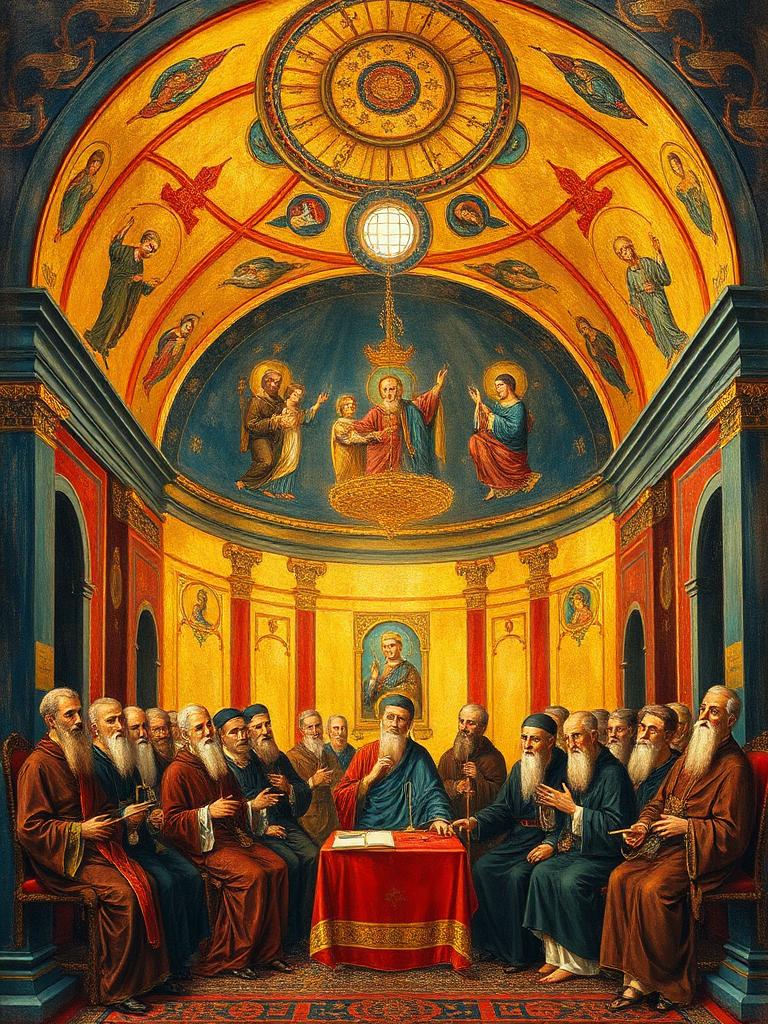
Byzantium · Theology · AD 726 – 843
A century of civil conflict over whether the divine can be depicted — and the philosophical defence that settled it.
Founder
Leo III against; John of Damascus for
Seat
Constantinople; Palestine
Practice
Destruction and later restoration of images, imperial edicts, monastic resistance, and the annual Triumph of Orthodoxy proclaimed in 843.
Afterlife
Unchanged by the dispute; the argument concerned mediation, not eschatology.
Legacy
Fixed the Orthodox visual tradition and produced a sophisticated theory of representation — sign, prototype and presence — still cited in aesthetics.
Byzantium · Theology · c. AD 1200 – 1453
The prayer of stillness, and a metaphysics distinguishing God's unknowable essence from his participable energies.
Founder
Gregory Palamas; the Athonite monks
Seat
Mount Athos
Practice
Solitude, silence, controlled breathing, ceaseless repetition of the Jesus Prayer, and obedience to a spiritual father.
Afterlife
Deification begun in this life and completed in the vision of the uncreated light.
Legacy
Vindicated by the councils of 1341–1351 against Barlaam's Aristotelian objections; carried into Russia and revived by the Philokalia in 1782.
Byzantium · Philosophy · AD 330 – 1453
The empire that argued about whether pagan learning was poison or medicine — and copied it anyway.
Founder
Basil the Great; Psellos; Plethon
Seat
Constantinople; Mistra
Practice
Manuscript copying in monastic scriptoria, the imperial school of higher studies, commentary and epitome, and a court culture of literary display.
Afterlife
Orthodox eschatology; the classical inheritance was method, not creed.
Legacy
Byzantine scribes preserved almost all surviving Greek literature; Plethon's lectures in Florence in 1439 helped ignite the Italian Renaissance.

c. 3100 BC – AD 400
The Order Called Maat
The longest continuous religious tradition of antiquity: a cosmos held in balance by ritual, kingship and the moral weight of a single feather.
Egypt
Egyptian religion was not a system so much as an accumulation — three thousand years of local cults, royal theologies and funerary technique layered without contradiction. Its organising idea was maat: truth, order, cosmic and social rightness, personified as a goddess and weighed as a feather against the heart of the dead.
Rival creation theologies coexisted comfortably. Heliopolis made Atum the self-created source of the Ennead; Memphis had Ptah think and speak the world into being; Thebes elevated Amun, the hidden one, into the imperial god of the New Kingdom. Akhenaten's Aten reform (c. 1353–1336 BC) was the great exception — a short, brutal attempt at exclusive worship that his successors erased.
Egypt
Death was an engineering problem with a moral component. The Pyramid Texts, Coffin Texts and Book of the Dead were operating manuals for the journey through the Duat, culminating in the weighing of the heart before Osiris and the forty-two judges.
Under the Ptolemies and Rome the tradition went international: Serapis was engineered as a Greco-Egyptian state god for Alexandria, Isis acquired temples from the Nile to Londinium, and Hermetic and Gnostic writings recast Egyptian priestly lore in Greek philosophical dress. The Temple of Philae, closed around 537, was the last to fall silent.
Egypt · What mattered most
Truth · balance · order
The law of the cosmos. Every act was judged by whether it upheld or unsettled harmony.
The quiet man
Wisdom texts (sebayt) praise the man who speaks calmly, avoids anger and acts with patience.
Honour to kin
Honouring parents and performing the funeral rites that keep a lineage — and a soul — alive.
Continuity
Stability along a predictable Nile: what endures is good, what is novel is suspect.
Egypt
State cult
c. 3100 BC – AD 300
Religion
c. 2700 – 1000 BC
Religion
c. 2400 BC – AD 400
Religion
c. 1353 – 1336 BC
Philosophy
c. 300 BC – AD 400
Egypt · State cult · c. 3100 BC – AD 300
The single idea beneath three thousand years: order must be actively maintained against the chaos (isfet) that surrounds it.
Founder
The Old Kingdom theologians
Seat
Memphis, Thebes, every temple
Practice
The daily offering of a figure of Maat by the king or his delegate, the awakening, washing, clothing and feeding of the cult statue in the sanctuary, and grand processional festivals such as Opet.
Afterlife
Admission depends on the heart weighing true against Maat's feather.
Legacy
The earliest developed articulation of an ethical cosmos, in which justice is not divine whim but the structure of reality.
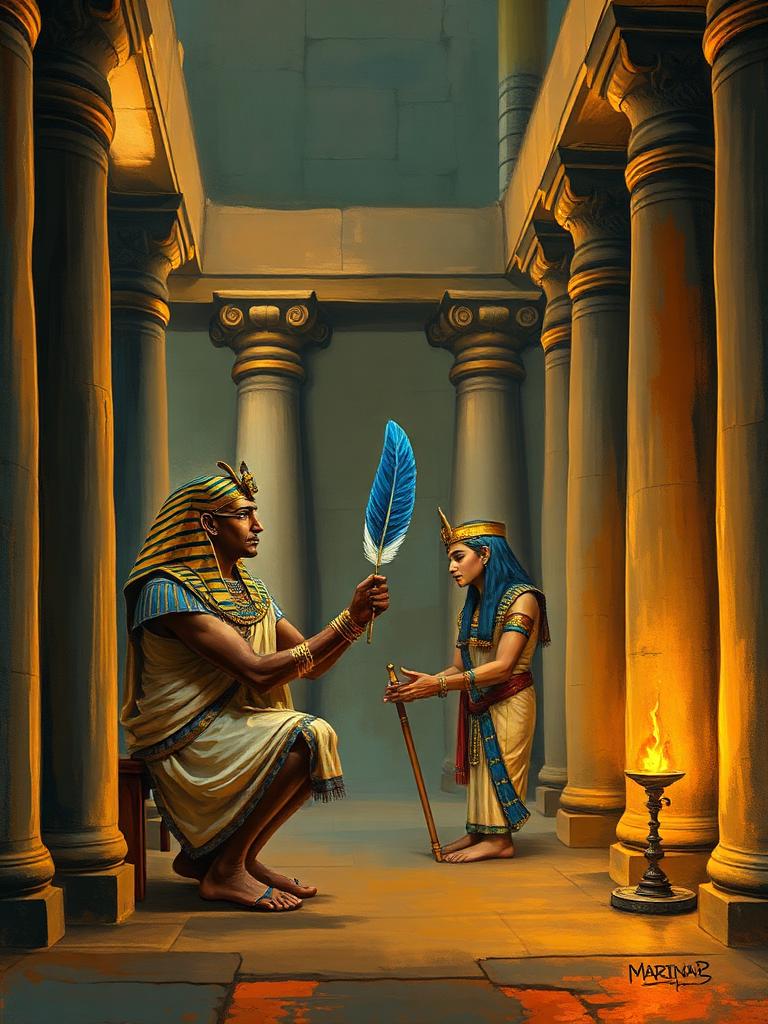
Egypt · Religion · c. 2700 – 1000 BC
Four cities, four accounts of how the world began — held simultaneously without contradiction.
Founder
Priesthoods of Heliopolis, Memphis, Hermopolis, Thebes
Seat
Iunu, Men-nefer, Khmun, Waset
Practice
Temple theology recorded on stelae and papyri, priestly commentary, and the syncretic fusion of deities — Amun-Ra, Ptah-Sokar-Osiris — as political fortunes shifted.
Afterlife
Continuous re-enactment: each sunrise repeats the first morning of creation.
Legacy
The Memphite doctrine of creation by the spoken word is the closest ancient parallel to later logos theology.
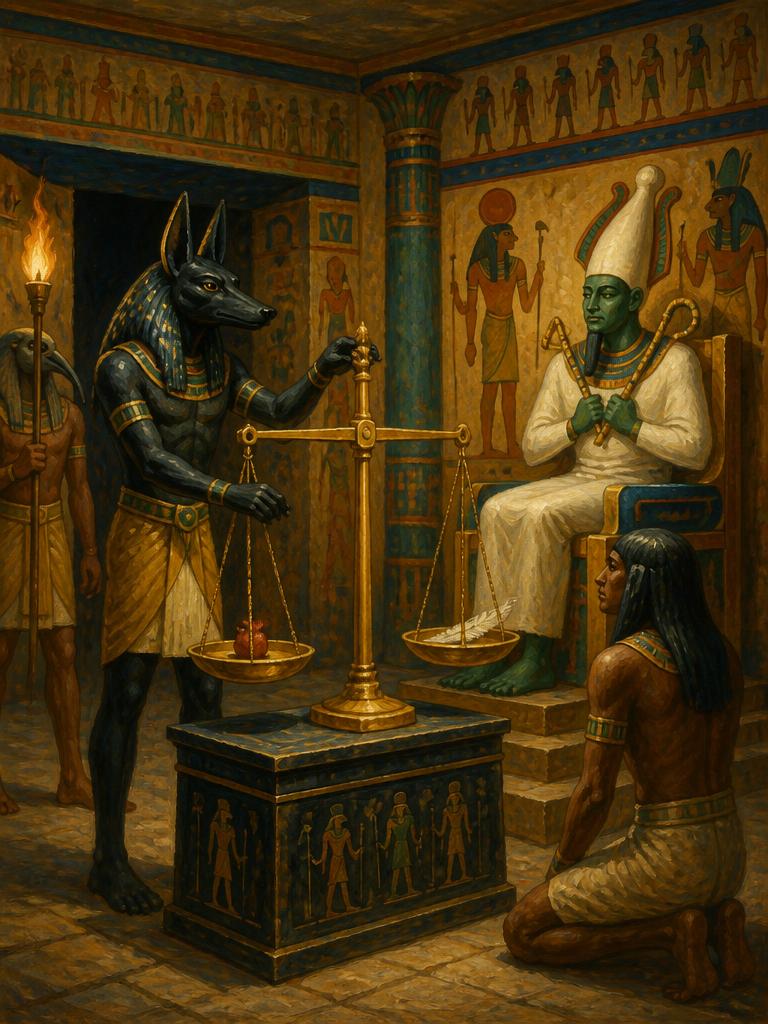
Egypt · Religion · c. 2400 BC – AD 400
A murdered god, restored by his wife and vindicated by his son — and a court in which every human being is tried.
“I have not caused pain; I have not caused tears; I have not killed.”
Founder
Pyramid Text tradition, democratised in the Middle Kingdom
Seat
Abydos
Practice
Mummification over seventy days, the Opening of the Mouth ceremony, tomb goods and shabtis, funerary spells from the Book of the Dead, and pilgrimage to Abydos.
Afterlife
The vindicated dead join the sun's circuit and the Field of Reeds; the condemned cease to exist.
Legacy
The oldest surviving doctrine of a moral post-mortem judgement, and the direct source of the Greco-Roman Isis mysteries.
Egypt · Religion · c. 1353 – 1336 BC
The one radical break in Egyptian religious history: a single visible god, a closed temple system, and an erased memory.
Founder
Akhenaten
Seat
Akhetaten (Amarna)
Practice
Worship in roofless sun-courts open to the sky, offering tables under direct light, and a new naturalistic art with the Great Hymn to the Aten as its text.
Afterlife
Sharply reduced: the dead awaken with the sunrise in the royal city rather than travelling the Duat.
Legacy
Reversed within a generation and Akhenaten condemned as the enemy; still the most-debated candidate for an antecedent of monotheism.
Egypt · Philosophy · c. 300 BC – AD 400
Egyptian priestly wisdom rewritten in Greek — a designed state god and a body of mystical philosophy attributed to Thrice-Great Hermes.
Founder
Ptolemy I; the Hermetic authors
Seat
Alexandria; the Serapeum
Practice
Incubation and healing at the Serapeum, philosophical dialogue in the Corpus Hermeticum, astrology, alchemy and ritual invocation.
Afterlife
Ascent and divinisation of the mind; regeneration described as a rebirth in this life.
Legacy
The Serapeum was destroyed in 391, but the Hermetica, translated by Ficino in 1471, shaped Renaissance magic, alchemy and the early scientific imagination.
Part two
Twenty-nine moments when a settlement between faith and reason was made, broken or rewritten.
Chronology · 3100 BC – 530 BC
Egypt · 3100 BC
Sacred kingship established; the pharaoh becomes the living Horus and sole legitimate priest.
Egypt · 2400 BC
The oldest religious literature in the world is carved in the pyramid of Unas at Saqqara.
Egypt · 1353 BC
The Aten is proclaimed sole god and the temples of Amun are closed. The experiment dies with its author.
Greece · 800 BC
The Greek pantheon acquires a canonical genealogy and a shared literary vocabulary.
Greece · 600 BC
The first attempt to explain the cosmos from a single natural principle rather than from myth.
Greece · 530 BC
A philosophical brotherhood teaching transmigration, harmony and mathematical order.
Chronology · 509 BC – 301 BC
Rome · 509 BC
With the Republic, religion becomes a department of public law under pontiffs and augurs.
Greece · 399 BC
Condemned for impiety and corrupting the young — philosophy and civic religion collide in court.
Greece · 387 BC
The first enduring institution of higher learning in Europe; it teaches for over nine centuries.
Greece · 335 BC
Empirical research, logic and the first great library-based research programme.
Greece · 307 BC
Atomism, friendship and withdrawal offered as a cure for fear of gods and death.
Greece · 301 BC
Stoicism begins under the Painted Porch in Athens.
Chronology · 300 BC – AD 161
Egypt · 300 BC
Ptolemy I creates a hybrid god to bind Greek and Egyptian Alexandria together.
Rome · 204 BC
The Senate imports the Phrygian Cybele by decree during the Hannibalic war.
Rome · 27 BC
Rome and Augustus are worshipped jointly across the provinces; loyalty becomes liturgy.
Rome · AD 30
A Jewish messianic sect emerges in Judaea and spreads through the empire's cities.
Rome · AD 80
A secretive, seven-graded soldiers' cult spreads along every Roman frontier.
Rome · AD 161
A reigning emperor keeps a private Stoic notebook that becomes antiquity's most-read philosophy.
Chronology · AD 245 – AD 451
Rome · AD 245
Neoplatonism gives paganism its most rigorous metaphysical form.
Rome · AD 313
Constantine and Licinius grant toleration; persecution ends and imperial patronage begins.
Byzantium · AD 325
The first ecumenical council defines the Son as homoousios with the Father.
Byzantium · AD 380
Theodosius I makes Nicene Christianity the religion of the Roman state.
Egypt · AD 391
Alexandria's great temple is torn down; Egyptian public cult enters its final decline.
Byzantium · AD 451
Two natures in one person — and a permanent split with the Miaphysite East.
Chronology · AD 529 – AD 1341
Byzantium · AD 529
The Athenian school loses its endowment; the last pagan philosophers leave for Persia.
Byzantium · AD 537
Empire and liturgy fuse in a building designed to look like heaven.
Byzantium · AD 726
A century of conflict over images produces a lasting theology of representation.
Byzantium · AD 843
Icons are restored permanently and the Byzantine visual tradition is fixed.
Byzantium · AD 1341
The essence-energies distinction is affirmed; hesychasm becomes Orthodox doctrine.
Part three
Four civilizations, one questionnaire: cosmos, cult, conscience, authority, afterlife and dissent.
Side by side
Arche, the Forms, or the rational logos pervading matter
The numinous power of place, state and emperor, borrowed from Greek theory
A Trinitarian God whose essence is unknowable and whose energies are shared
Maat — order — sustained by gods and king against chaos
Side by side
Argument, dialectic and observation
Ancestral custom (mos maiorum), augury and legal precedent
Scripture, council, and the consensus of the Fathers
Priestly transmission and the correct performance of ancient rite
Side by side
Doing the customary things for the city's gods
Exact procedure that maintains the pax deorum
Holding right belief and receiving the sacraments
Living by maat and sustaining the daily temple service
Side by side
A soul that may be immortal, tripartite and educable
A citizen defined by duty, family and the genius within
An image of God, wounded but destined for deification
A composite of ka, ba, akh, name and shadow, all requiring upkeep
Side by side
Grey Hades — unless initiated or philosophically purified
Ancestral shades honoured rather than described
Resurrection, judgement, and the vision of uncreated light
Judgement by weight of heart; the Field of Reeds or annihilation
Side by side
Cult is a civic function; philosophy is private and sometimes suspect
Religion is a branch of public law; philosophy trains the governing class
Doctrine is imperial policy; heresy is a public offence
The king is the sole priest; the state is the cult
Part four
Sages, bishops, emperors and one freed slave — the people who framed the answers.
Portraits
c. 535–475 BC · Presocratic
Reality is process; the logos is the measure within the flux.
469–399 BC · Moral gadfly
Definition of the virtues is the first task of a serious life.
428–348 BC · Founder, the Academy
The Forms are real; the visible world is their shadow.
384–322 BC · Founder, the Lyceum
Everything is understood through its end — its purpose.
341–270 BC · Founder, the Garden
Fear of gods and death is the root of misery; physics removes both.
334–262 BC · Founder, the Stoa
Live in agreement with nature, which is to live by reason.
Portraits
106–43 BC · Statesman, eclectic
Translated Greek philosophy into Latin and into political language.
4 BC–AD 65 · Stoic, minister to Nero
Philosophy is therapy administered in letters.
AD 50–135 · Freed slave, teacher
Freedom is the correct use of impressions.
AD 121–180 · Emperor, Stoic
Do the work in front of you as a citizen of the cosmos.
AD 204–270 · Neoplatonist
All things flow from the One and long to return to it.
AD 354–430 · Bishop of Hippo
Neoplatonic ascent rewritten as grace, will and interior time.
Portraits
AD 330–379 · Cappadocian Father
Use pagan letters as the bee uses the flower.
c. AD 500 · Mystical theologian
God is best approached by unknowing and negation.
AD 675–749 · Defender of images
Because God took matter, matter can bear his image.
AD 1018–1078 · Court philosopher
Revived Plato at the heart of an Orthodox court.
AD 1296–1359 · Hesychast theologian
God's energies are shared though his essence is not.
c. 2400 BC · Vizier, sage
The oldest surviving wisdom instruction: speak measuredly, act by maat.
Portraits
c. 2650 BC · Architect, later deified
Human wisdom elevated to divinity — a god of healing by the Late Period.
d. c. 1336 BC · Heretic pharaoh
One visible god, and the king as its only interpreter.
legendary, texts c. AD 100–300 · Attributed sage
As above, so below: the mind is kin to the divine.
Part five
Fourteen terms in Greek, Latin and Egyptian that the rest of the deck depends on.
Lexicon
Lexicon
Lexicon
Sacra et Ratio
Greece argued, Rome legislated, Byzantium defined, Egypt maintained. Each answer survives inside the vocabulary we still use for order, conscience and the soul.